How to Build a Halfling Bard in D&D 5e
Halfling bards work because they nail the fundamentals of the class without compromise. You get the Charisma you need for spellcasting and social encounters, plus Dexterity that keeps you alive in combat—and the Lucky trait means you can reroll that failed save or missed attack when it matters most. The Brave feature shores up a traditional bard weakness too, making you more resistant to fear effects than you’d expect for a small character. This combination creates a character who genuinely feels fortunate in ways that play out at the table, not just in flavor text.
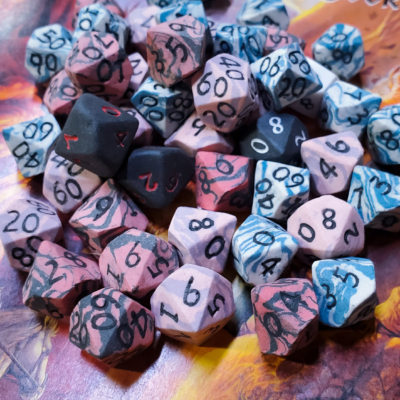
The Pink Delight Ceramic Dice Set‘s warm tones complement the halfling’s inherent warmth and charm, making it an ideal choice for tracking those crucial Lucky trait rerolls.
Why Halfling Works for Bard
Halflings bring three mechanical advantages that complement the bard’s playstyle. First, their +2 Dexterity matters more than many players realize. Bards are light armor wearers who rely on Dexterity for AC, initiative, and finesse weapon attacks. Starting with 17 Dexterity after racial bonuses means you can prioritize Charisma at character creation while maintaining respectable defenses.
Second, the Lucky trait is phenomenal for a class that concentrates on spells regularly. When you roll a natural 1 on a concentration check, you get to reroll it. This keeps your battlefield control spells like Hypnotic Pattern or your buff spells like Haste active through more damage than other races could manage. It also applies to saving throws, meaning you’re less likely to get locked down by enemy casters.
Third, Brave gives you advantage on saves against being frightened. This matters because frightened is one of the few conditions that can shut down a bard’s effectiveness—you can’t approach enemies to deliver touch spells or inspirations, and ranged spell attacks have disadvantage. Dragon breath weapons, certain spells, and high-CR monsters love fear effects. Halflings shrug them off.
The size limitation rarely matters. You can’t use heavy weapons, but bards don’t want them anyway. Small size can actually be tactical—squeezing through tighter spaces and taking cover behind medium-sized allies.
Subrace Choice: Lightfoot vs. Stout
Lightfoot halflings get +1 Charisma and Naturally Stealthy, which lets you hide behind creatures one size larger than you. This is the obvious choice for most bards. The Charisma boost puts you at 16 Charisma with standard array or point buy, and the stealth synergy works beautifully for espionage-focused campaigns or any situation where you need to infiltrate, scout, or simply avoid becoming the primary target.
Stout halflings get +1 Constitution, advantage on saves against poison, and poison damage resistance. This is the defensive option. If your campaign features lots of poisoners, yuan-ti, or underdark adventures, Stout is legitimate. The Constitution bonus also helps with concentration, hit points, and general survivability. However, you’re trading away a Charisma point, which means reaching 20 Charisma takes longer. Only choose Stout if you know you need the survivability or if your table uses the optional rule allowing you to move racial ability score increases.
Best Bard Colleges for Halflings
College of Lore remains the strongest mechanical choice. The bonus skills at 3rd level make you even more of a skill monkey, and Cutting Words gives you another way to spend Bardic Inspiration defensively. By 6th level, Magical Secrets lets you cherry-pick powerful spells from other class lists. This is where halfling bards truly shine—grabbing Counterspell, Fireball, or Spirit Guardians turns you into a flexible caster who can adapt to any situation. The Lucky trait stacks beautifully with Cutting Words to control dice outcomes.
College of Eloquence from Tasha’s Cauldron of Everything deserves serious consideration. Silver Tongue ensures your Persuasion and Deception checks can’t roll below 10, and Unsettling Words lets you subtract from an enemy’s save before your spell hits. This makes your control spells significantly more reliable. At 6th level, Unfailing Inspiration means your Bardic Inspiration dice return on a failure, which feels thematically perfect for a lucky halfling who always seems to have a second chance.
College of Glamour works if you want a more fey-themed character. Enthralling Performance and Mantle of Inspiration both provide strong battlefield control and support, and the fey flavor matches halfling folklore well. This is less about mechanical optimization and more about character concept, but it’s completely viable.
College of Swords is the only bard subclass that genuinely struggles as a halfling. You want Strength or at least high Dexterity for weapon attacks, and while halflings get the Dexterity, you’re splitting focus between weapon damage, spellcasting, and AC. It works, but you’d be better served playing a different race with martial weapon proficiencies or extra attack features.
Ability Score Priority and Starting Stats
With point buy or standard array, your priorities look like this: Charisma first, Dexterity second, Constitution third. Dump Strength without hesitation—you’re never making Strength-based attacks or checks that matter. Intelligence, Wisdom, and Constitution compete for your remaining points.
A strong starting spread for a Lightfoot halfling bard using point buy: Str 8, Dex 15 (+2 racial = 17), Con 13, Int 10, Wis 12, Cha 15 (+1 racial = 16). This gives you a +3 Charisma modifier and +3 Dexterity modifier immediately, with both stats positioned to hit 18 at 4th level with a half-feat or 20 at 8th level.
When your bard’s personality shines through in roleplay, the Dreamsicle Ceramic Dice Set brings that same whimsical, enchanting energy to your dice rolls during pivotal moments.
Alternatively, if you’re playing Stout: Str 8, Dex 15 (+2 racial = 17), Con 14 (+1 racial = 15), Int 10, Wis 12, Cha 14. You sacrifice one point of Charisma but gain better concentration and survivability.
Recommended Feats for Halfling Bards
Fey Touched or Shadow Touched are both exceptional at 4th level. Each gives you +1 to Charisma, bringing you to 17, plus a 1st-level and 2nd-level spell. Fey Touched (Misty Step + Bless or Hex) or Shadow Touched (Invisibility + Inflict Wounds or False Life) expand your spells known and give you freebies once per long rest. The half-feat nature means you’re not delaying your primary stat growth.
War Caster becomes important once you’re concentrating on powerful spells regularly and holding a weapon or focus in one hand and a shield in the other. Advantage on concentration checks stacks beautifully with your racial Lucky trait—you can reroll natural 1s, and you roll with advantage. The opportunity attack casting is situational but occasionally clutch.
Lucky (the feat) is absurd on halflings. You already reroll 1s naturally. Adding three luck points per long rest that work on any d20 roll—yours or an enemy’s—creates moments where you control combat outcomes through pure luck manipulation. This is for players who enjoy leaning into the “lucky halfling” trope to the point of mechanical absurdity.
Resilient (Constitution) at higher levels rounds out an odd Constitution score and gives you proficiency in Constitution saves. Combined with advantage from War Caster, your concentration becomes nearly unbreakable. This is an 8th or 12th level pick after you’ve maxed Charisma.
Background Recommendations
Entertainer is the obvious thematic choice and mechanically solid. You get proficiency in Performance and Acrobatics, plus a musical instrument and disguise kit. The By Popular Demand feature ensures you can find places to perform for room and board, which matters in campaigns with downtime and travel.
Criminal or Charlatan both work beautifully for halfling bards focused on skills and infiltration. Criminal gives you proficiency in Stealth and Deception along with thieves’ tools, making you a capable backup rogue. Charlatan provides Deception and Sleight of Hand with a disguise kit and forgery kit, perfect for con artist characters.
Guild Artisan provides interesting roleplaying opportunities and two tool proficiencies. A halfling bard who’s also a master craftsperson (instrument maker, jeweler, or cook) adds depth beyond “wandering musician.” The guild connections can drive plot hooks and provide resources in cities.
Far Traveler from Sword Coast Adventurer’s Guide gives you Insight and Perception, making you better at reading social situations and noticing threats. The All Eyes on You feature creates interesting social dynamics where NPCs are curious about your foreign origins.
Playing Your Halfling Bard
In combat, position yourself where you can see allies for inspiration delivery and enemies for control spells, but not so close that area effects catch you. Your Lucky trait matters most when you’re maintaining concentration on a crucial spell—let the tank absorb hits, but don’t hide so far back you can’t affect the battlefield. Use your size to take cover behind larger party members.
Out of combat, you’re the face of the party and the skill specialist. With Expertise and Jack of All Trades, you can handle almost any skill check the party encounters. Halfling bards excel at information gathering, negotiation, and solving problems without violence.
Many experienced players keep a Single D20 Die Ceramic Dice Set nearby for quick concentration checks, initiative rolls, and those make-or-break saving throws that define your session.
Building a halfling bard means leaning into luck and party support as your core strengths. You won’t outdamage your wizard or outlast your barbarian, but you’ll make both of them significantly more effective while keeping yourself standing through a mix of skill and circumstance. The right college and feat choices amplify these strengths, turning a naturally good combination into something that feels genuinely luck-driven and essential to your party’s success.