
Druids are the strangest, most flexible class in 5e, and that’s exactly why people bounce off them. You’re not just casting Entangle and turning into a wolf—you’re juggling Wild Shape’s action economy, deciding whether your bear form’s HP pool is better spent than a 2nd-level spell slot, and quietly running the most resource-rich kit in the game. The class rewards system mastery and punishes autopilot. Pick the wrong subclass for your table and you’ll feel like a worse Cleric with a salad fixation. Pick the right one and you’re reshaping encounters before the fighter finishes their first attack.
Here’s the honest truth: Circle of the Moon gets all the press because turning into a Brown Bear at level 2 is genuinely busted, but Circle of Stars, Shepherd, and Spores each solve different problems at the table. Land Druid is criminally underrated if your DM actually enforces short rests. And if you’ve never run Conjure Animals past a DM who lets you pick the summons, you haven’t really played the class.
This hub is where we’ve parked everything—subclass breakdowns, Wild Shape stat block cheat sheets, spell rankings by tier, multiclass dips that actually pull their weight (looking at you, two-level Cleric splash), and the matchup notes you need when your party already has a full caster. Whether you’re rerolling after a TPK or building your first character from scratch, start here and follow the links to whatever’s burning a hole in your character sheet.
WILDSHAPE! That single word comes up at our booth more than any other when we get chatting with Druid players about what hooked them on the class. There’s something about the freedom of becoming a bear one round, a dire wolf the next, and maybe a giant spider for the sneaky bits that really speaks to the folks who gravitate toward Druids. We’ve noticed Druid players tend to be thoughtful, observant types who love the natural world and often have a deep stack of homebrew lore about their character’s grove or circle. They’re usually the player at the table asking the DM detailed questions about the weather, the local flora, or what kind of trees line the road. They lean toward characters who feel deeply connected to something bigger than themselves, and they often roleplay with a quiet wisdom that grounds the whole party.
When it comes to dice, Druid players almost always reach for sets with earthy, organic tones, swirls of green, brown, mossy textures, or anything that looks like it was pulled from a forest floor. Our Forgotten Forest Ceramic Dice Set set gets snatched up quickly by Druid players who love the natural color palette, and our Moss Druid Ceramic Dice Set set is another favorite for folks who want their dice to feel like a piece of the wild itself.
Featured Dice for Druid Players
Hand-picked ceramic dice sets from Crit Hit Ceramics that complement Druid characters at the table.
Coming Soon
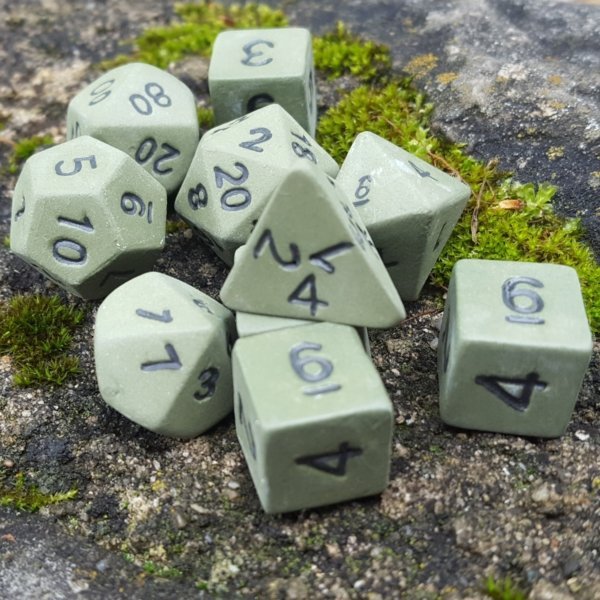
Forgotten Forest Ceramic Dice Set
Deep, mossy green hand-pigmented English porcelain with bold black numbering. A handmade ceramic dice set for druids, wood elves, and fey…
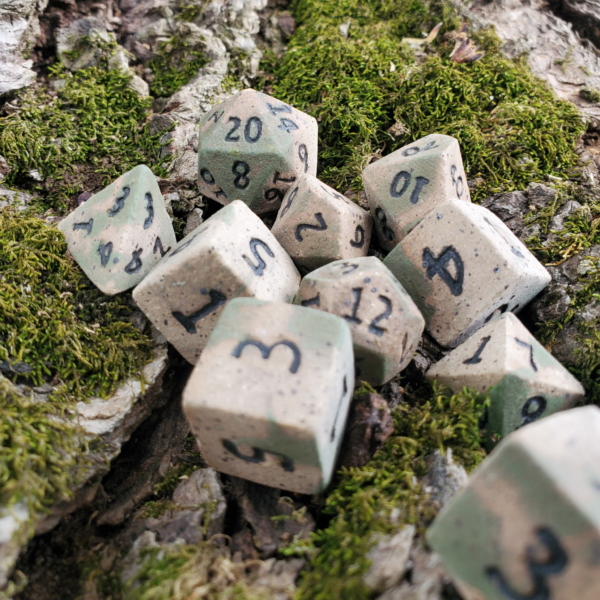
Moss Druid Ceramic Dice Set
Green hand-pigmented English porcelain combined with 112 stoneware in an earthy green-and-brown fusion. A handmade ceramic dice set for d…

Coming Soon
Wintergreen Blue Ceramic Dice
Orc Monk's Wintergreen Blue DND Dice offers an immersive gaming experience with its high-quality ceramic build. The unique Wintergreen Bl…
Druid Core Mechanics
The Druid is a full Wisdom-based caster with a d8 hit die and saving throw proficiencies in Intelligence and Wisdom—an excellent defensive profile against mind-affecting magic and illusions. Constitution isn’t a saving throw proficiency, but it’s your secondary stat because nearly every powerful Druid spell (Conjure Animals, Call Lightning, Sleet Storm) requires concentration.
What New Players Need to Know:
- You’re a full spellcaster with access to spell slots up to 9th level, preparing spells daily from the entire Druid list (you don’t learn them like a Sorcerer).
- Ritual Casting lets you cast prepared ritual spells without expending a slot—use it for utility magic like Detect Magic, Speak with Animals, and Commune with Nature.
- Druidcraft is your signature flavor cantrip: predict weather, bloom a flower, snuff a candle. It defines the Druid’s bond with nature.
- Druidic is a secret language only Druids know—useful for leaving messages in the wild.
- Wild Shape lets you transform into beasts you’ve seen, gaining their stats while keeping your mental scores. At low levels, this is a survival tool; at higher levels, it becomes scouting, infiltration, and emergency hit points.
What Surprises Experienced Players:
The “no metal armor” rule is not a mechanical prohibition—it’s a roleplay restriction with no listed penalty. Most tables enforce it anyway as flavor. Plan around hide, leather, and wooden shields.
The real tension in Druid play is Wild Shape versus spellcasting. Transforming usually ends concentration on your spells, forcing a choice: be a caster controlling the battlefield, or be a beast soaking damage. Moon Druids resolve this through brute combat forms; Land Druids lean into spell-slinging.
At 18th level, Beast Spells finally breaks the trade-off—you can cast any spell with somatic or verbal components while Wild Shaped, fully unifying the Druid’s two identities.
Choosing Your Druid Circle
At 2nd level, every Druid joins a Circle that defines their magical traditions and combat style. With seven official subclasses spanning four sourcebooks, the Druid has one of the most diverse subclass rosters in 5e, ranging from gentle healers to terrifying necromancers.
Circle of the Land (PHB) is the classic caster Druid, gaining bonus spells tied to a specific terrain—Arctic, Coast, Desert, Forest, Grassland, Mountain, Swamp, or Underdark (with Xanathar’s adding more options). Each terrain unlocks unique spells like spike growth (Grassland) or water walk (Coast), and Natural Recovery lets you regain spell slots on a short rest.
Circle of the Moon (PHB) transforms Wild Shape into a combat juggernaut. You can transform as a bonus action, assume CR 1 beast forms at level 2, and spend spell slots to heal in beast form, making you a frontline bruiser who rivals martial classes in durability.
Circle of Dreams (Xanathar’s) channels Feywild magic for healing and mobility. Hearth of Moonlight and Shadow protects your party during rests, Balm of the Summer Court grants bonus action healing dice, and later features let you teleport allies across the battlefield.
Circle of the Shepherd (Xanathar’s) is the premier summoner subclass. Spirit Totems buff allies and debuff enemies in a 30-foot aura, and Mighty Summoner makes your conjure animals and similar spells dramatically more powerful with bonus HP and magical attacks.
Circle of Spores (Tasha’s) embraces fungal necromancy. Halo of Spores deals reaction damage to nearby enemies, Symbiotic Entity grants temporary HP and doubled spore damage, and at higher levels you animate corpses as fungal zombies—a rare necromantic playstyle for Druids.
Circle of Stars (Tasha’s) turns you into a celestial astrologer. Starry Form offers three modes (Archer for ranged damage, Chalice for healing, Dragon for concentration and skills), and Cosmic Omen lets you grant bonuses or penalties to nearby creatures’ rolls.
Circle of Wildfire (Tasha’s) pairs destructive fire with vibrant rebirth. Your Wildfire Spirit companion deals fire damage and teleports allies, while bonus spells like scorching ray and flaming sphere give you offensive options most Druids lack, balanced by healing and revival magic.
Best Race Combinations for Druid
Druids need Wisdom first and Constitution second to maintain concentration on spells like Conjure Animals and Call Lightning. The best race pairings push those stats while adding flavorful utility that complements nature magic.
Wood Elf Druid — The gold standard. +2 Dexterity, +1 Wisdom, 35 ft. speed, and Mask of the Wild for hiding in natural terrain make this the quintessential scout-caster.
Firbolg Druid — +2 Wisdom and +1 Strength, plus innate Detect Magic, Disguise Self, and the ability to turn invisible. Built from the ground up to be a forest guardian.
Variant Human Druid — Grab Resilient (Constitution) or War Caster at level 1 for rock-solid concentration saves. Flexible ability scores let you max Wisdom early.
Hill Dwarf Druid — +2 Constitution and +1 Wisdom is the perfect concentration package, and Dwarven Toughness gives you extra HP per level for surviving Wild Shape rebounds.
Ghostwise Halfling Druid — +2 Dexterity and +1 Wisdom, plus telepathic Silent Speech that lets your Wild Shape communicate without speech limitations.
Kenku Druid — A roleplay-heavy pick with Dexterity bonuses and Mimicry that gets creative around Wild Shape’s speech restrictions. Dive deeper in How to Build a Kenku Druid, explore the curse in Kenku Druid Synergies, and learn mimicry tricks in Working With Curse and Mimicry.
Aasimar Druid — Celestial Resistance protects concentration from necrotic and radiant damage, and Healing Hands stacks with your support kit. Full breakdown in How to Build an Aasimar Druid.
Dragonborn Druid — Awkward stat spread (+2 Strength, +1 Charisma), but breath weapons give you a reliable AoE outside spell slots. See How to Build a Dragonborn Druid and the focused Green Dragonborn Druid guide for poison-themed builds that lean into poison as a strength.
Water Genasi Druid — Constitution and Wisdom bonuses, a swim speed, and innate Create or Destroy Water. Perfect for Circle of the Sea or coastal campaigns.
Goliath Druid — Stone’s Endurance soaks damage to preserve concentration, while Mountain Born ignores high-altitude penalties for sky-roaming campaigns.
Tabaxi Druid — Feline Agility doubles your speed, stacking with Wild Shape forms for unmatched battlefield mobility.
Druid Build Archetypes
The Druid class flexes between roaring beast, calculating spellcaster, and commander of nature’s legions. Here are four proven archetypes to shape your next character.
1) Moon Druid Bear/Dinosaur Tank
The Circle of the Moon Druid weaponizes Wild Shape as a frontline juggernaut. Transform into a Brown Bear at level 2 or an Allosaurus at level 5 to soak hits and pounce on enemies, swapping forms when one HP pool runs dry. Key features: combat Wild Shape (bonus action at level 2), elemental forms at higher tiers, and effectively double HP through transformations.
2) Land Druid Caster
The Circle of the Land Druid is a full-caster powerhouse focused on battlefield control. Lock down encounters with Spike Growth, Plant Growth, and Sleet Storm while leveraging your chosen terrain’s bonus spell list. Key features: Natural Recovery for spell-slot regen, terrain-specific spells, and unmatched area denial.
3) Shepherd Summoner
The Circle of the Shepherd Druid raises an army through Conjure Animals and Summon Fey. Your spirit totems empower the pack with temporary HP, advantage on saves, or extra damage, turning every fight into a swarm. Key features: Spirit Totem aura, Mighty Summoner (bonus HP and magical attacks), and action-economy domination.
4) Stars Druid Versatile
The Circle of Stars Druid shifts between Starry Forms for tailored buffs each round. Switch to Archer for ranged radiant damage, Chalice for healing allies, or Dragon for stable concentration on key spells. Key features: three constellation modes, Guiding Bolt at-will via Star Map, and exceptional flexibility without spending Wild Shape on combat transformations.
Combat Tactics & Action Economy
Wild Shape functions as a second HP bar: when your beast form drops to 0, you revert with your original HP intact and only lose the action used to transform. Use forms like Giant Elk (charge + knockdown) or Brown Bear (34 HP, multiattack) as expendable frontline buffers. Drop Wild Shape early (bonus action at level 18, else action) when you need to cast a leveled spell—reverting mid-combat to drop a Healing Word or Plant Growth is often correct. Don’t hoard charges; you regain both on a short rest.
Conjure Animals is your action-economy crown jewel. Eight wolves (CR 1/4) provide pack tactics, knockdown on hit, and roughly 56 collective HP of disposable threat. DM-chosen creatures? Negotiate beforehand. Once summoned, your action is largely free for cantrips while the pack auto-attacks—position them to flank for advantage chains with martials.
Concentration triage: Conjure Animals pairs badly with another concentration spell, so pre-buff before casting. Faerie Fire or Pass Without Trace go up first, then drop Conjure Animals turn one. Pass Without Trace (+10 Stealth to all allies within 30 ft) trivializes ambushes and infiltration—it’s arguably the strongest 2nd-level spell in the game.
Spirit Guardians on a Wild Shaped Druid (via Moon’s tankier forms at higher tiers) doesn’t work—Wild Shape blocks casting. Instead, cast Spike Growth or Sleet Storm, then Wild Shape to engage and force enemies through the difficult terrain you created.
Frequently Asked Questions About Druids
Is Moon Druid overpowered?
Moon Druid is exceptionally strong at low levels (2-4), where transforming into a Brown Bear gives you massive temporary hit points and solid damage. However, it falls off in the mid-to-late game as beast stats don’t scale as well as monster threats. While it’s not truly “overpowered,” it’s one of the strongest early-game subclasses in 5e. Many DMs allow it without issue, but expect to shine brightest during your first few adventures.
Can Druids wear metal armor?
Technically, yes. The Player’s Handbook states Druids “will not” wear metal armor, framing it as a cultural taboo rather than a mechanical restriction. There’s no rules penalty for breaking this tradition. However, most tables treat it as a roleplay rule, and Druids who violate it might face in-character consequences from their order. Discuss with your DM, but expect pushback if you try to optimize with a metal breastplate.
How does Wild Shape actually work?
Wild Shape lets you transform into a beast you’ve seen, using a bonus action (after level 2 for Moon Druids, regular action for others). You gain the beast’s stats, HP, and abilities while retaining your Intelligence, Wisdom, Charisma, and class features. You can stay transformed for hours equal to half your Druid level. When the beast’s HP hits zero, you revert to your normal form with any remaining damage carrying over only if excess.
Best Druid subclass?
It depends on playstyle. Circle of the Moon excels at frontline combat through powerful Wild Shape forms. Circle of Stars (Tasha’s) is arguably the strongest overall, offering versatile star forms, bonus action healing, and excellent action economy. Circle of Spores blends necromancy with melee combat creatively. Circle of the Land remains a solid caster-focused option. For pure power, Stars and Moon top most tier lists, while Spores offers the most unique flavor.
Best Druid race?
With updated rules allowing ability score flexibility, almost any race works. Popular choices include Wood Elf for stealth and speed, Firbolg for thematic synergy and innate magic, Variant Human for a feat at level 1, and Goliath for Moon Druid tankiness. Ghostwise Halfling offers telepathy for staying connected in Wild Shape. Ultimately, pick a race whose features complement your subclass—Moon Druids benefit from Constitution boosts, while caster-focused Druids want Wisdom.
Is Druid good for new players?
Druids are powerful but can overwhelm new players due to their complexity. Managing spell preparation, Wild Shape mechanics, and tracking beast stat blocks requires bookkeeping. Circle of the Land is more beginner-friendly since it focuses on traditional spellcasting. Moon Druid, despite being strong, demands familiarity with multiple stat blocks. If you’re new to D&D, consider starting with a simpler class like Fighter or Cleric, then tackle Druid once you understand core mechanics.
Browse All Druid Content
Our complete library:
By Race Combination (16)
- How to Build a Kenku Druid in D&D 5e
- Kenku Druid Synergies: Turning Limitations Into Strengths
- Kenku Druid: Working With Curse and Mimicry
- Kenku Druid: Navigating Speech and Wild Shape
- How to Play a Kenku Druid in D&D 5e
- How to Play a Kenku Druid Through Mimicry
- Kenku Druid: Overcoming Mimicry And Wild Shape
- How to Build a Dragonborn Druid in D&D 5e
- How to Build a Green Dragonborn Druid in D&D 5e
- Green Dragonborn Druid: Trading Stats For Breath Weapon Power
- How to Build a Green Dragonborn Druid
- Green Dragonborn Druid: Working With Awkward Stats
- Green Dragonborn Druid: Playing Poison as Your Strength
- Green Dragonborn Druid: Concept Over Optimization
- How to Build an Aasimar Druid in D&D 5e
- Aasimar Druid: Celestial Wings And Wild Shape Synergies